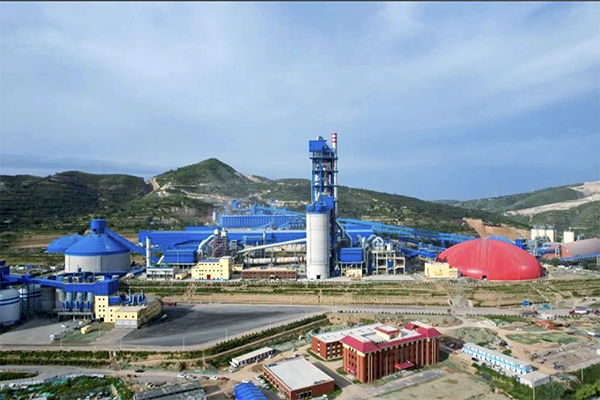
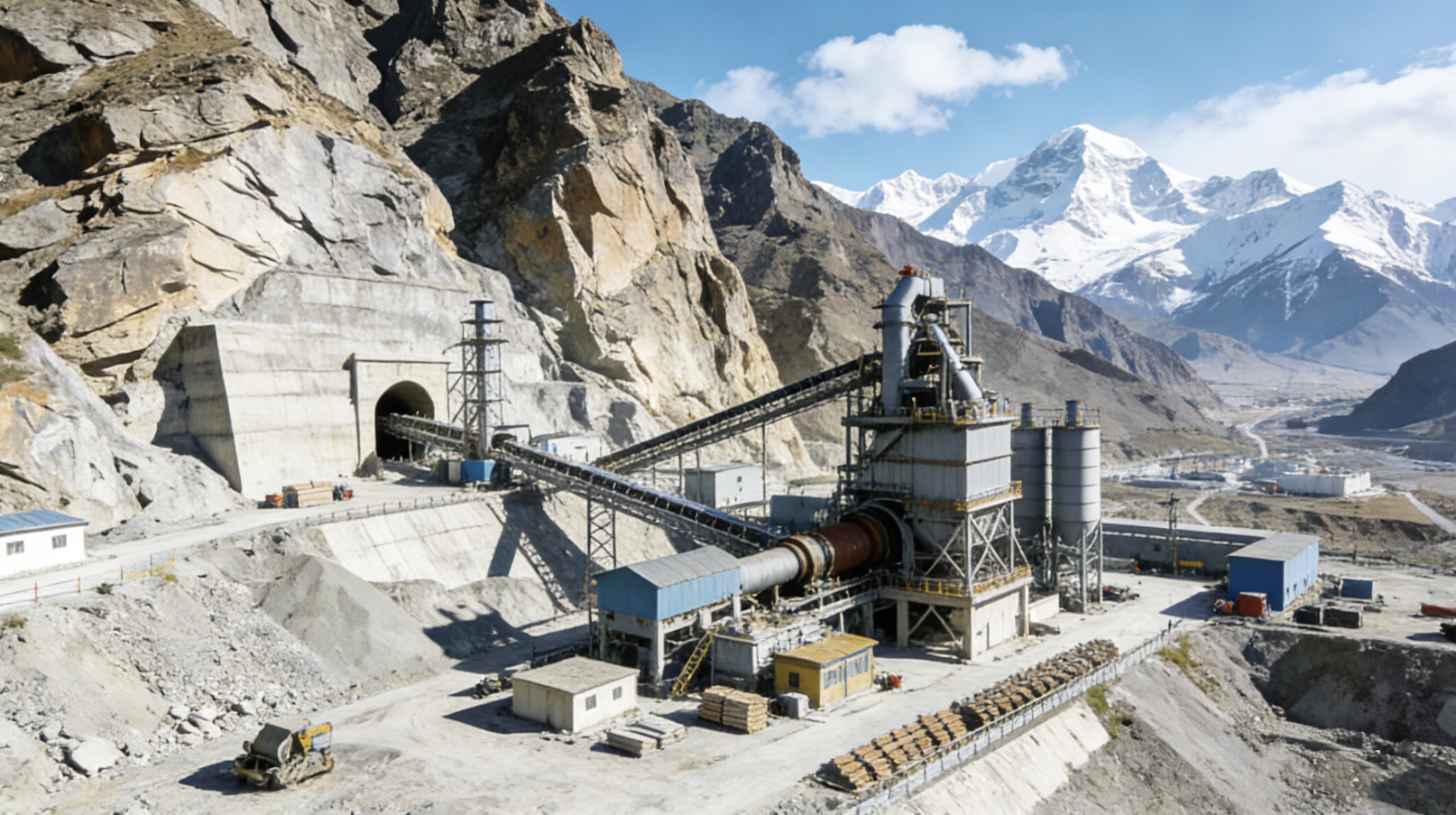
Process Parameters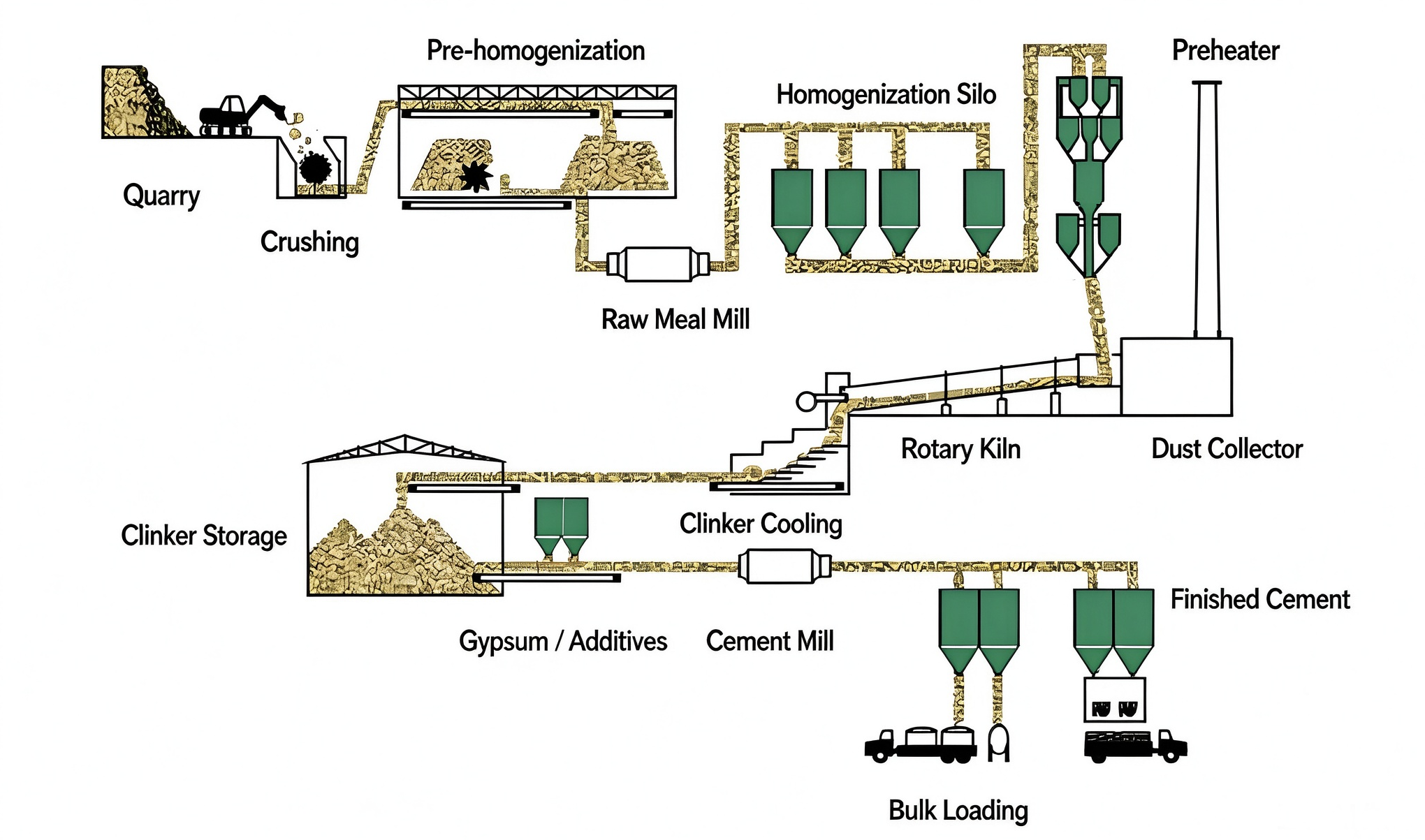
In cement production, manufacturing one ton of Portland cement requires grinding 3 tons of materials (including various raw materials, fuels, clinker, admixtures and gypsum). Statistics show that grinding operations in a dry-process cement production line account for more than 60% of the total plant power consumption. Among them, raw material grinding accounts for over 30%, coal grinding about 3%, and cement grinding approximately 40%. Therefore, proper selection of grinding equipment and process flow, optimization of process parameters, correct operation and control of operating regimes are critical to guaranteeing product quality and reducing energy consumption.
Production Process
Cement production uses limestone and clay as the main raw materials. The raw materials go through crushing and proportioning, then are ground into raw meal by a vertical mill. The raw meal is fed into a cement rotary kiln and calcined into clinker. Afterwards, the clinker is mixed with an appropriate amount of gypsum together with some admixtures or additives, then subjected to roller pressing by a roller press and further ground in a cement mill to produce cement. Finally, the finished cement is delivered out of the plant via packing machines or bulk loaders.
According to different raw meal preparation methods, the prevailing process adopted at present is the dry process: raw materials are dried and ground simultaneously, or dried first and then ground into raw meal powder, which is subsequently fed into a dry-process rotary kiln for calcination into clinker. There is also a semi-dry process, in which raw meal powder is mixed with proper water to form raw meal pellets and then calcined in a Lepol kiln; this is still categorized as a type of dry production.
The main advantage of the dry process is low heat consumption. For dry kilns equipped with preheaters, the heat consumption of clinker ranges from 3140 to 3768 J/kg. Its disadvantages include difficulty in achieving uniform raw meal composition, heavy dust emission in workshops and relatively high power consumption.
Parameters of Small-scale Cement Production Line
| Annual Capacity | Clinker Output per Day | Raw Meal Mill | Rotary Kiln Size | Cement Mill | Main Equipment List |
|---|---|---|---|---|---|
| 20,000 TPY | ~60 t/d | Φ1.4m Vertical Mill / Ball Mill | Φ1.6×32m Rotary Kiln | Φ1.8×7m Cement Ball Mill | Crusher, Pre-homogenization Yard, Raw Meal Silo, 4-stage Preheater, Grate Cooler, Bag Dust Collector, Packer |
| 50,000 TPY | ~150 t/d | Φ1.7m Vertical Mill | Φ2.0×36m Rotary Kiln | Φ2.2×8m Cement Ball Mill | Crusher, Pre-homogenization Yard, Raw Meal Homogenization Silo, 4-stage Preheater, Grate Cooler, Roller Press, Baghouse Dust Collector, Packing & Bulk System |
| 100,000 TPY | ~300 t/d | Φ2.2m Vertical Mill | Φ2.5×40m Rotary Kiln | Φ2.4×9m Cement Mill + Roller Press | Double-stage Crusher, Pre-homogenization Yard, Raw Meal Silo, 5-stage Preheater, Grate Cooler, Roller Press Pre-grinding System, Dust Collection, DCS Control |
| 200,000 TPY | ~600 t/d | Φ2.6m Vertical Mill | Φ3.0×46m Rotary Kiln | Φ2.8×10m Cement Mill + Roller Press | Jaw & Hammer Crusher, Pre-homogenization Yard, Raw Meal Silo, 5-stage Preheater, 3rd Gen Grate Cooler, Roller Press, Complete Dust Removal, DCS |
| 300,000 TPY | ~900 t/d | Φ3.0m Vertical Mill | Φ3.2×48m Rotary Kiln | Φ3.2×11m Cement Mill + Roller Press | Two-stage Crushing, Pre-homogenization Yard, Raw Meal Silo, 5-stage Preheater, 3rd Gen Grate Cooler, Combined Grinding System, Environmental Dust Collector, DCS Central Control |
Main Production Equipment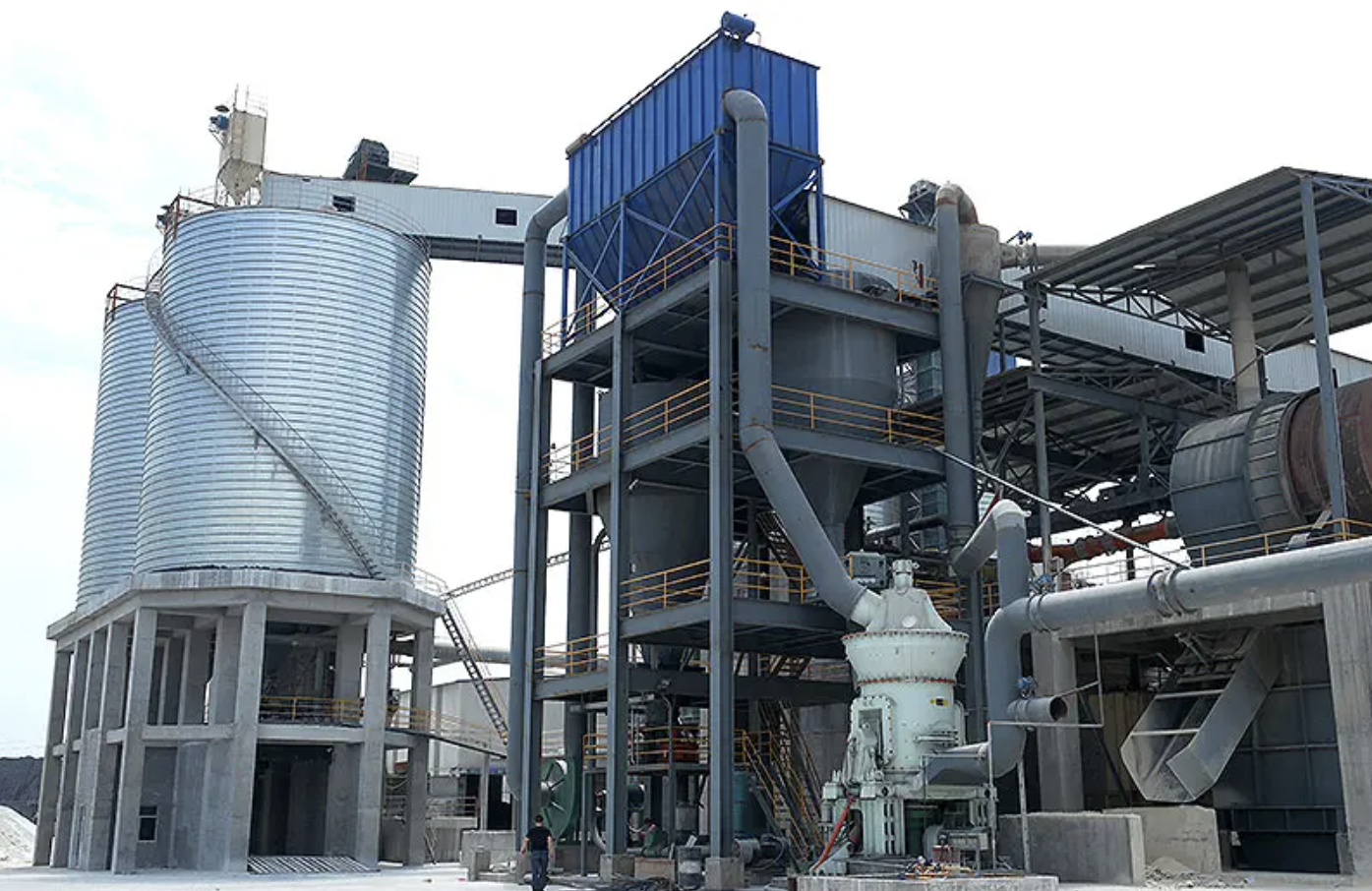
The main equipment of the cement production line includes cement rotary kiln, cyclone preheater, cooler, crusher, vertical mill, roller press, cement mill, coal mill, dryer, dust collector, packing machine, bulk loader, conveyor, electrical control system, etc.
(1) Crushing: Raw materials such as limestone, clay, iron ore and coal need to be crushed. Limestone is the most widely used raw material in cement production. Mined limestone features large particle size and high hardness, so limestone crushing plays a vital role in material crushing at cement plants.
(2) Raw Material Pre-homogenization: Pre-homogenization technology applies scientific stacking and reclaiming techniques during material storage and extraction to achieve preliminary homogenization of raw materials. In this way, the raw material stockyard serves both storage and homogenization purposes.
The preheater completes preheating and decomposition of cement raw meal, undertaking part of the functions of the rotary kiln and shortening the kiln length. While materials are under suspension preheating, gas-material heat exchange takes place. Raw meal mixes fully with the hot flue gas discharged from the rotary kiln, expanding the contact area between gas and solid materials. It delivers fast heat transfer and high heat exchange efficiency, boosting the production capacity of the rotary kiln system and reducing the heat consumption for clinker calcination.
(1) Material Dispersion Around 80% of heat exchange for the raw meal fed into the preheater duct occurs in the inlet pipeline. Impacted by the high-speed upward airflow, the materials turn to move upward along with the gas flow and get dispersed at the same time.
(2) Gas-Solid Separation When the powder-laden airflow enters the cyclone, it is forced to rotate downward in the annular gap between the cyclone shell and inner tube. The airflow spirals down from the cylinder section to the cone tip, then reverses direction and spirals upward before discharging through the exhaust pipe.
The advent of precalcination technology marks a major technological breakthrough in cement calcination processes. A calciner is installed between the preheater and rotary kiln. Fuel injection units are arranged on the riser duct at the kiln tail. The exothermic combustion of fuel and the endothermic carbonate decomposition of raw meal proceed rapidly in suspension or fluidized state inside the calciner, lifting the decomposition rate of raw meal entering the kiln to over 90%.
The carbonate decomposition, which originally takes place inside the rotary kiln, is transferred to the calciner. Most fuel is injected into the calciner, and only a small fraction is fed from the kiln head. This reduces the thermal load of the calcining zone inside the kiln, extends the service life of refractory lining and supports large-scale production. Uniform mixing of fuel and raw meal enables timely heat transfer from combustion to materials, optimizing the processes of combustion, heat exchange and carbonate decomposition.
After preheating and precalcination in the cyclone preheater, the raw meal is sent into the rotary kiln for clinker burning. Inside the rotary kiln, carbonates decompose rapidly and a series of solid-phase reactions occur to form mineral phases of cement clinker. As the material temperature rises, partial minerals turn into liquid phase, and reactions in the liquid phase form clinker minerals. Once clinker is calcined, its temperature begins to drop. The high-temperature clinker discharged from the rotary kiln is cooled by the clinker cooler to a temperature suitable for downstream conveying, storage silos and cement mills. Meanwhile, the sensible heat of hot clinker is recovered to improve the system thermal efficiency and clinker quality.
Cement grinding is the final and most power-consuming procedure in cement production. It grinds cement clinker to a proper fineness and forms a reasonable particle size distribution, increasing the hydration surface area and accelerating the hydration rate to meet the setting and hardening requirements of cement paste.
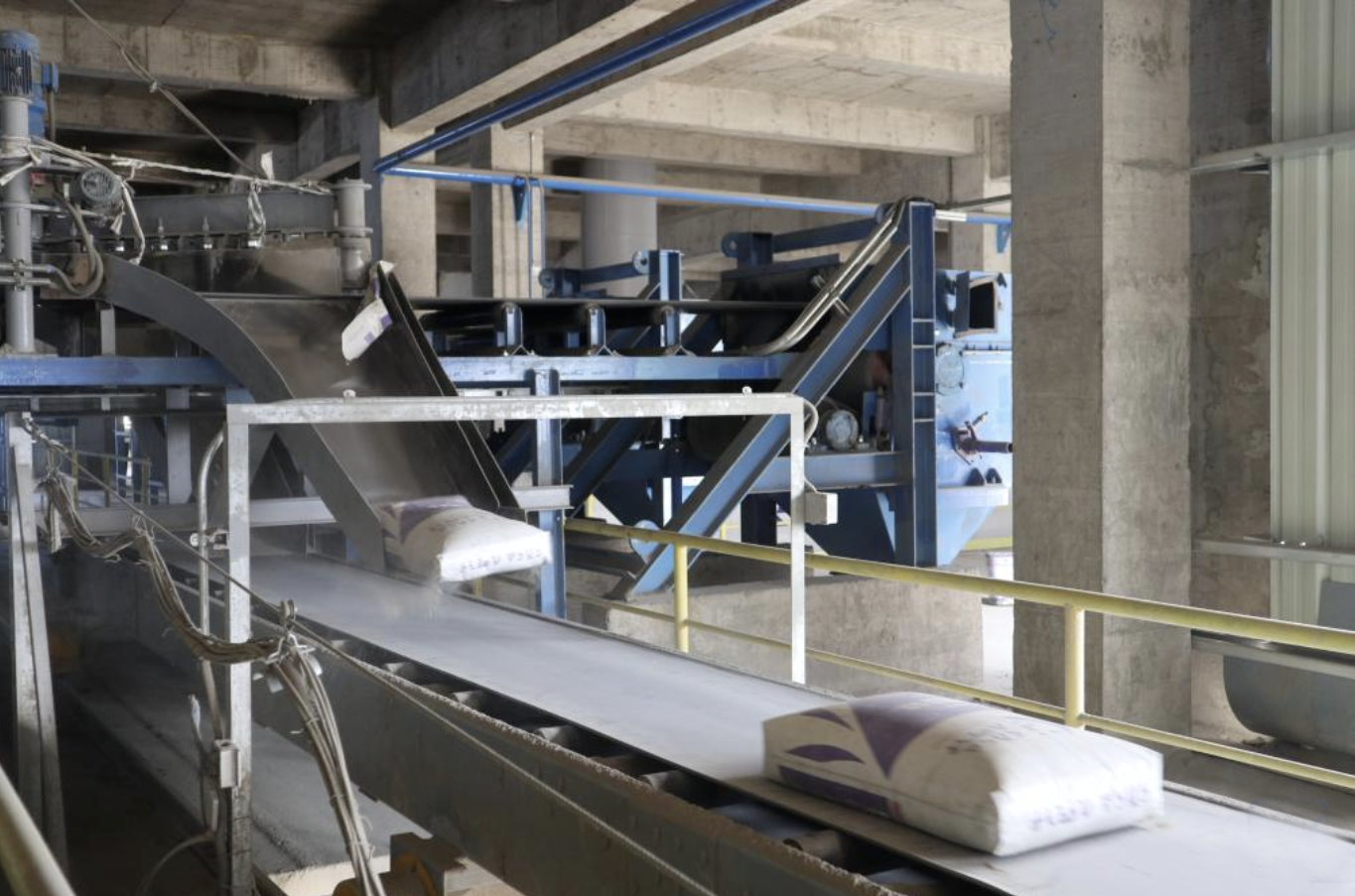
Finished cement is delivered out of the plant in two forms: bagged cement and bulk cement.

Submit Request